Issue 001 · Designer Series

Designer Eye View

Learn to See Like a Designer

Read the Magazine →
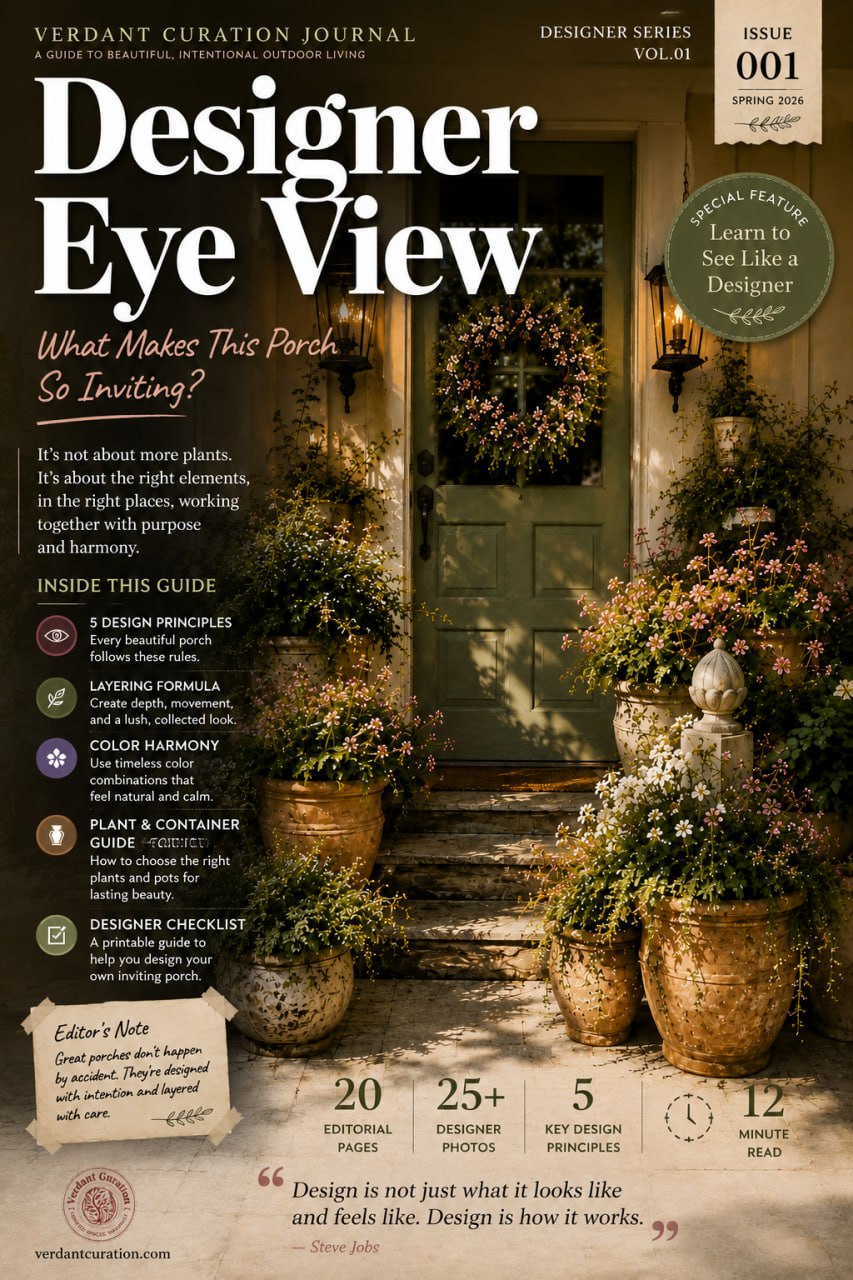
Designer Eye View — Complete Magazine Cover
The Designer's First Look
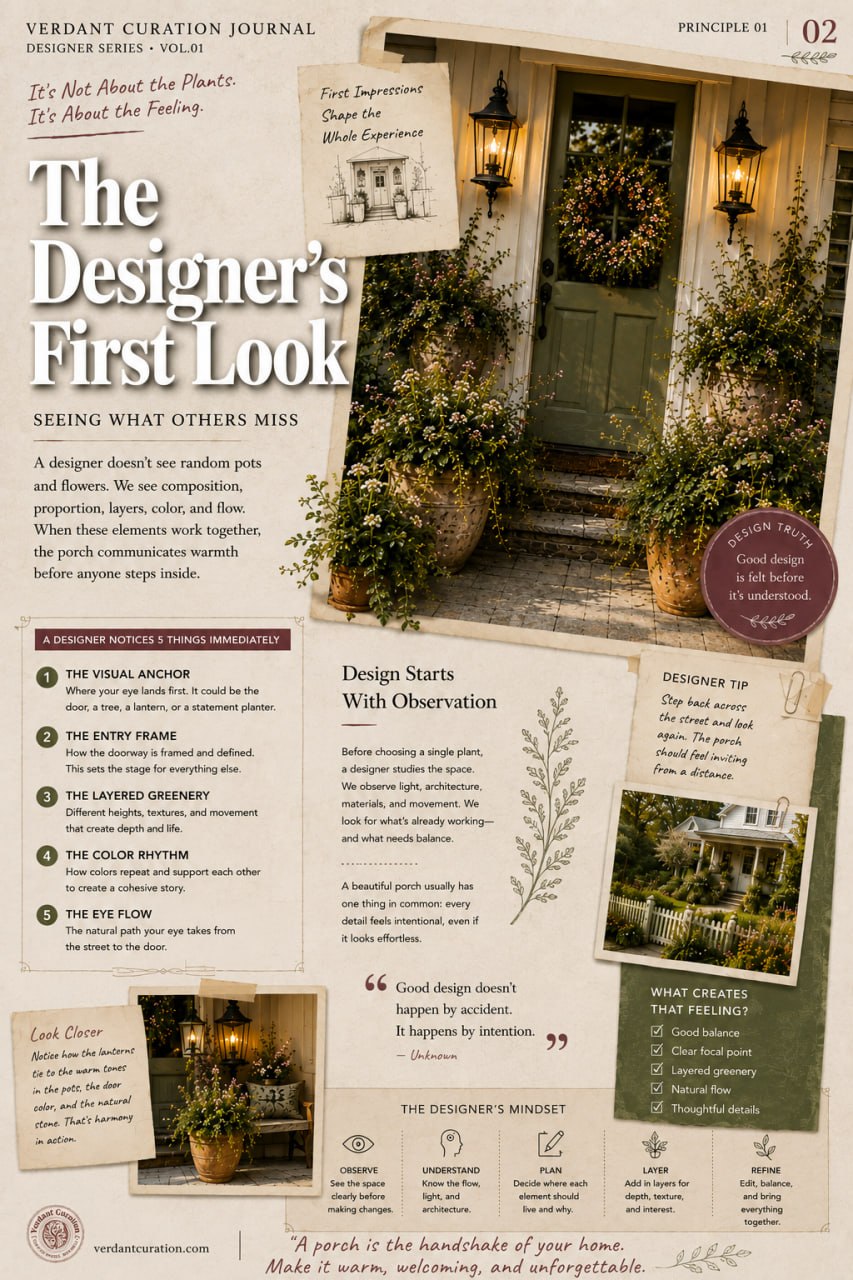
VC Journal inside cover — The Designer's First Look with composition analysis
The designer's first look — reading proportion, flow, and the silent language of materials.
A designer doesn't see random pots and flowers. We see composition, proportion, layers, color, and flow.

When these elements work together, the porch communicates warmth before anyone steps inside. A designer studies the space before choosing a single plant — the architecture, the light, the materials, the movement. We look for what's already working and what needs balance.

A beautiful porch usually has one thing in common: every detail feels intentional, even if it looks effortless. The difference between "decorated" and "designed" is that the latter has a reason for every choice.

A Designer Notices 5 Things Immediately

  1. 1
    The Visual Anchor Where your eye lands first. It could be the door, a tree, a lantern, or a statement planter.
  2. 2
    The Entry Frame How the doorway is framed and defined. This sets the stage for everything else.
  3. 3
    The Layered Greenery Different heights, textures, and movement that create depth and life.
  4. 4
    The Color Rhythm How colors repeat and support each other to create a cohesive story.
  5. 5
    The Eye Flow The natural path your eye takes from the street to the door.

Good design doesn't happen by accident. It happens by intention. Before choosing a single plant, a designer observes the light, the architecture, the materials, and the movement. We look for what's already working — and what needs balance.

Design Starts With Observation. A beautiful porch usually has one thing in common: every detail feels intentional, even if it looks effortless.

The Designer's Mindset

👁 Observe See the space clearly before making changes.
🧠 Understand Know the flow, light, and architecture.
✏️ Plan Decide where each element should live and why.
🌿 Layer Add in layers for depth, texture, and interest.
Refine Edit, balance, and bring everything together.

What Creates That Feeling?

"Good design is felt before it's understood."

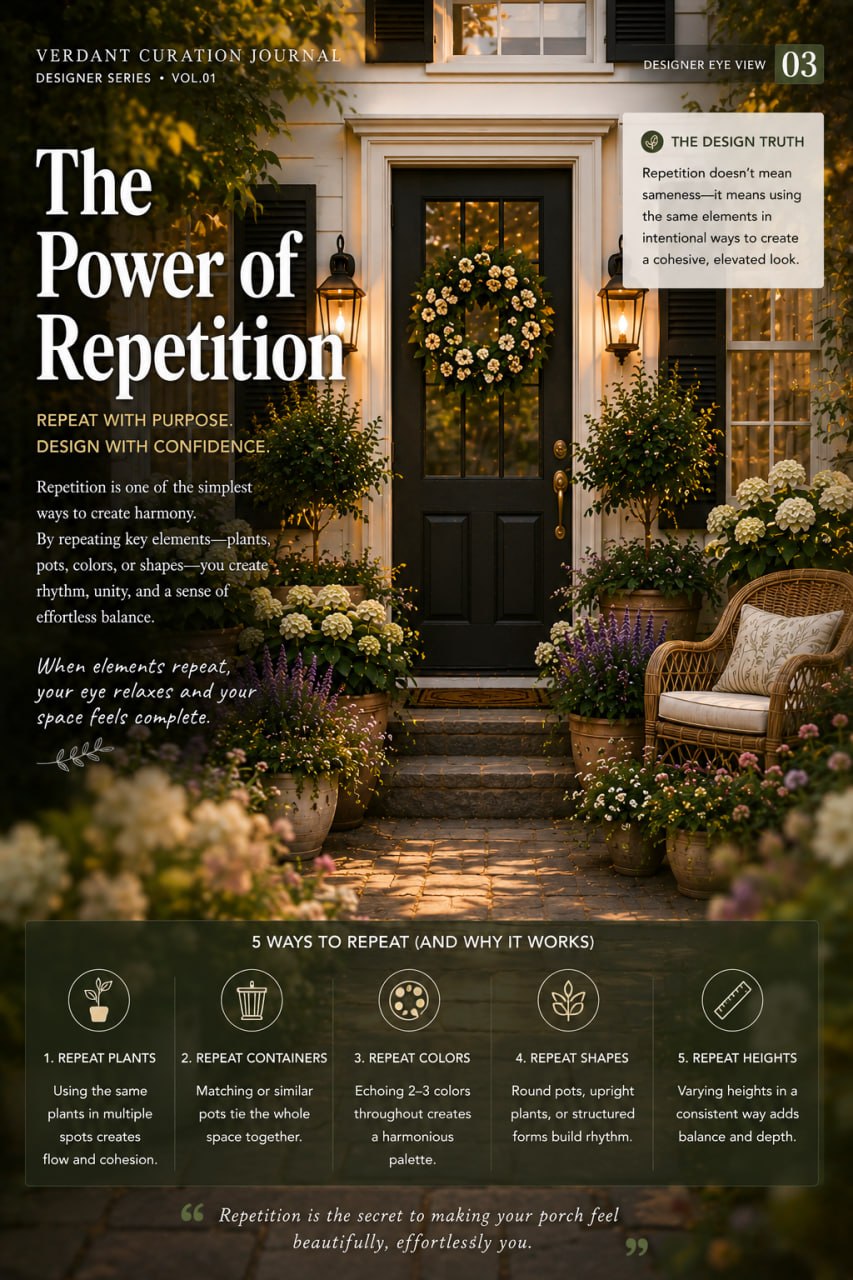
VC Journal — The Power of Repetition page with 5 Ways to Repeat infographic
Principle 01

The Power of Repetition

Repetition is one of the quietest forces in design — and one of the most powerful. When the same element appears more than once, your brain registers it as intentional. A row of matching pots. A repeated leaf shape. The same warm brown tone echoing through the doormat, the pot glaze, and the wicker armrest.

This doesn't mean everything must match. Repetition is not uniformity. You can repeat a color across different objects. You can repeat a shape — round pots, soft curves, arched foliage — without repeating the exact same item. You can repeat a rhythm: tall, medium, low — arranged like musical notes across the porch steps.

Design Truth

Repetition doesn't mean sameness — it means using the same elements in intentional ways to create a cohesive, elevated look.

Principle 02
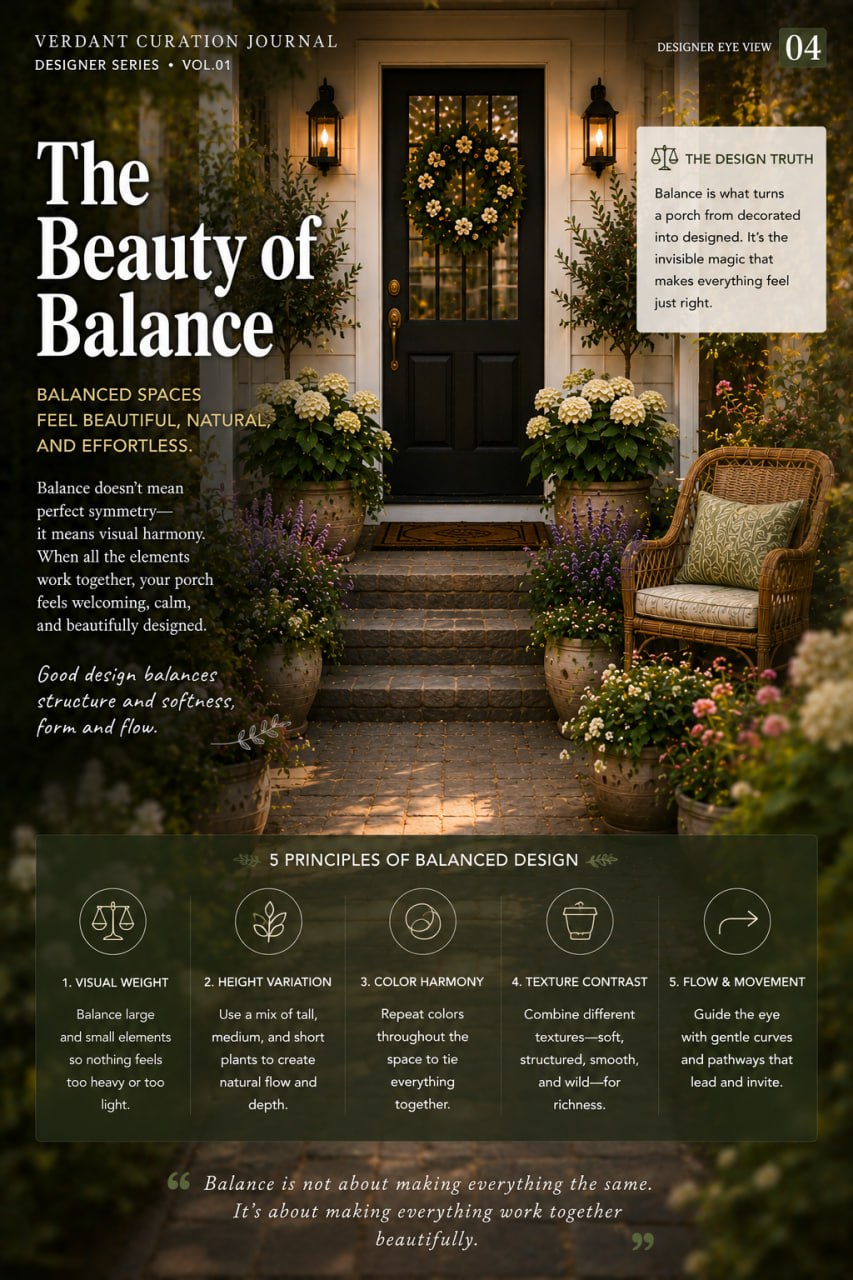
Designer Eye View page 04: The Beauty of Balance — principles of balanced porch design including visual weight, height variation, and texture contrast
Balance gives a porch its quiet confidence — nothing fights for attention, yet everything holds its place.

The Beauty of Balance

Balance isn't about symmetry. It's about making every element feel like it belongs exactly where it is.

Balance is the invisible structure that holds a porch design together. It's the reason some porches feel calm and composed while others feel chaotic and unsettled. At its heart, balance is about visual weight — the way our eyes distribute attention across the space. Every object, color, and texture carries weight, and a designer arranges them so no single area feels heavier than another.

Symmetrical balance — matching pairs of urns, identical lanterns on both sides of the door — creates formality and order. Asymmetrical balance, on the other hand, achieves equilibrium through contrast: a tall planter on one side balanced by a cluster of smaller pots on the other. Both approaches work. The choice depends on the personality of your home and the feeling you want to create.

The goal is not perfect symmetry. The goal is equilibrium. Step back and squint at your porch. Does one side feel heavier than the other? Does the eye rest somewhere uncomfortable? Those are your cues to restore balance — by adding, removing, or shifting elements until the whole composition breathes evenly.

Principle 03
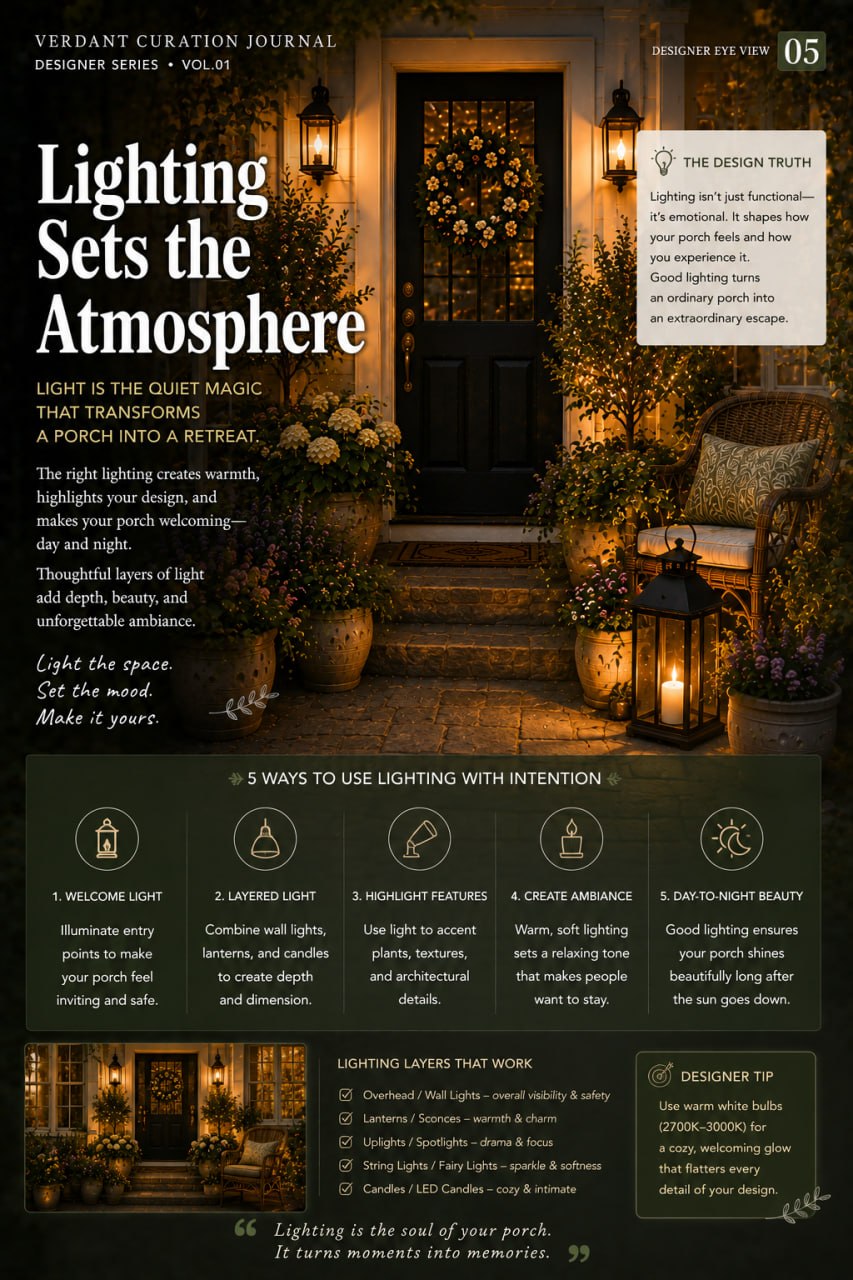
Designer Eye View page 05: Lighting Sets the Atmosphere — five ways to use porch lighting with intention for warmth and ambiance
Lighting is the difference between a porch that looks good and a porch that feels alive after dark.

Lighting Sets the Atmosphere

Plants and pots create the bones of a porch, but lighting gives it a soul. A well-lit porch extends the hours you can enjoy it, transforms the mood from day to night, and guides the eye to the details that matter most. Designers use light the way painters use a brush — to highlight, to shadow, and to create depth.

5 Ways to Use Porch Lighting With Intention

  1. 1
    Layer the Light Combine overhead, mid-level, and ground-level sources instead of relying on a single fixture. This creates depth and warmth.
  2. 2
    Highlight the Entrance Flank the door with sconces or pendant lights that frame the entry and draw the eye inward.
  3. 3
    Use Warm Tones Choose bulbs in the 2200K–2700K range. Cool white light erases the cozy feeling instantly.
  4. 4
    Light the Plants Uplights at the base of key planters create dramatic shadows and turn foliage into sculpture at night.
  5. 5
    Candlelight as Accent Real or LED candles on steps, ledges, or tables add a flickering human-scale warmth that fixtures can't replicate.

Good lighting doesn't shout. It invites. When you get it right, the porch becomes a different kind of space at night — softer, warmer, and full of quiet invitation.

"Lighting is the architecture of atmosphere."

Principle 04
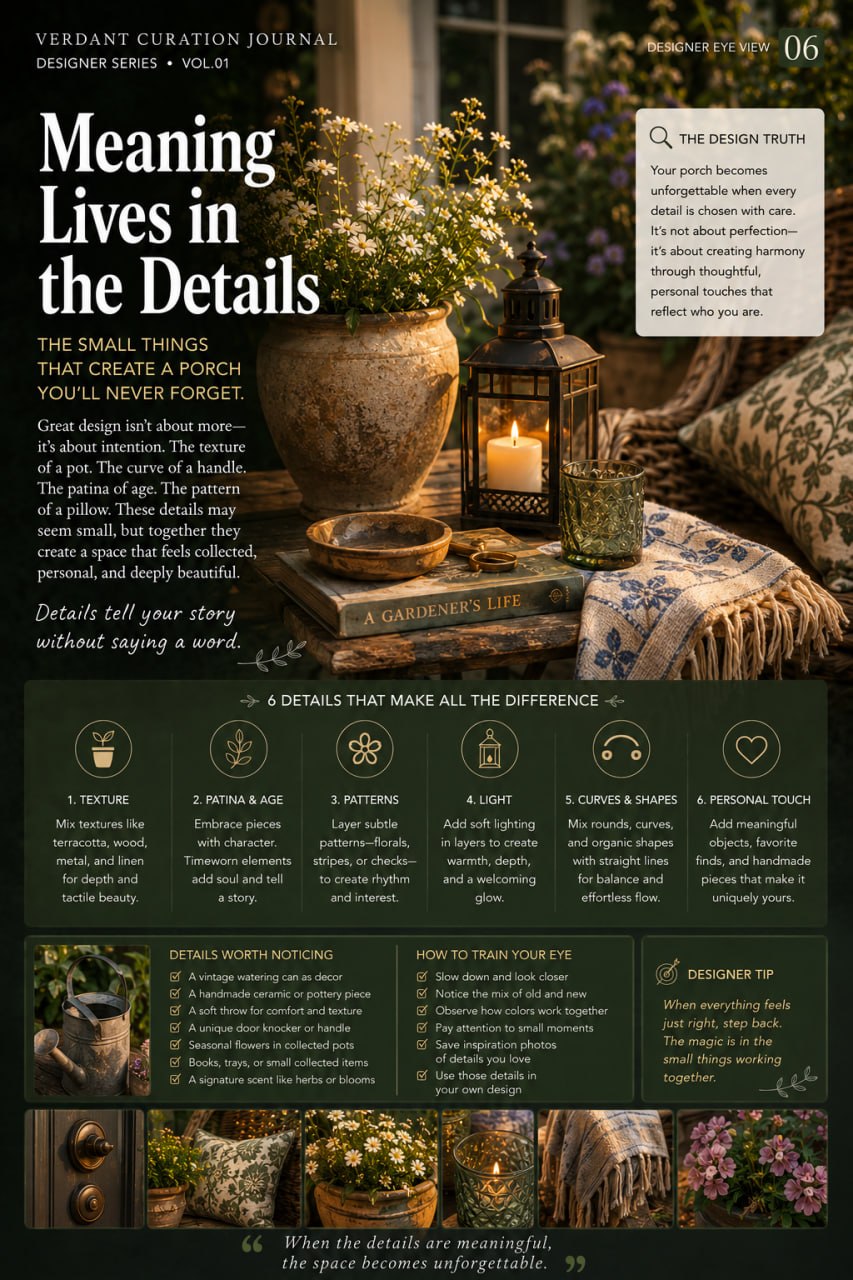
Designer Eye View page 06: Meaning Lives in the Details — small porch details that create a lasting impression including texture, patina, and personal touches
The difference between a good porch and a great one is almost always in the details.

Meaning Lives in the Details

A beautiful porch is built on big moves — the right containers, a balanced layout, layered plants — but a memorable porch lives in the details. It's the weathered patina on a brass faucet. The contrast of a rough terra-cotta pot against a smooth glazed one. A single unexpected object that makes someone pause and say, "That's lovely — where did you find that?"

Texture is the most underappreciated tool in porch design. Mix matte with gloss, rough with smooth, organic with refined. A stone urn next to a sleek modern planter. A rough-hewn wooden bench with a velvet cushion. These contrasts keep the eye engaged and the space feeling layered rather than flat.

Patina tells a story. Don't be afraid of wear. A rusted lantern, a weathered chair, a pot with moss growing on its rim — these are signs of life, not neglect. The most admired porches feel lived-in, not staged. They collect details over time like a home collects memories.

"Details are not decorations. They are the voice of the space."

Principle 05
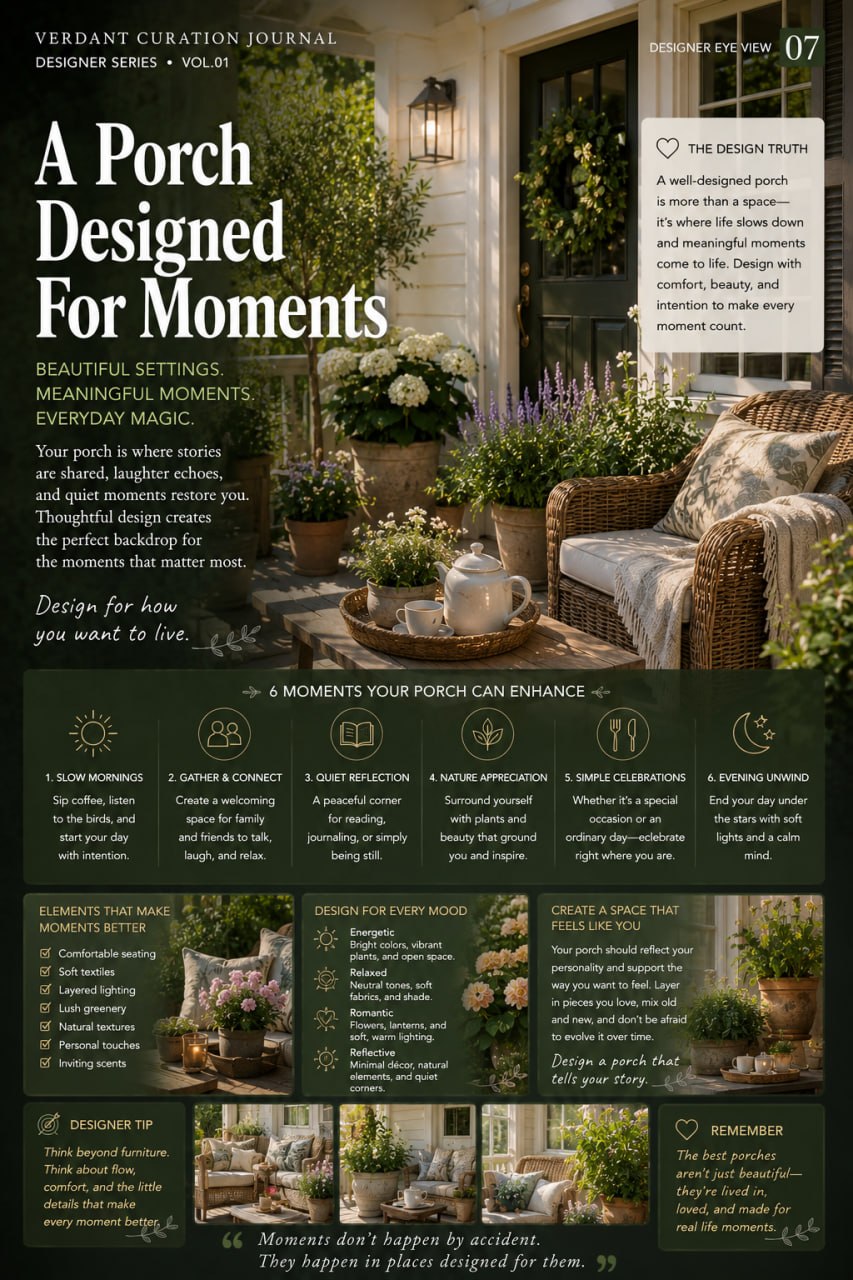
Designer Eye View page 07: A Porch Designed For Moments — creating meaningful everyday moments through thoughtful porch design
A great porch doesn't just look good — it creates a reason to pause, sit, and stay.

A Porch Designed For Moments

The best porches aren't just beautiful to look at — they pull you into an experience. They offer a place to set down a coffee cup. A corner where morning light falls just right. A seat that catches the evening breeze. These are designed moments, not accidents.

When a designer plans a porch, we think about how people will use it at different times of day. Where does the morning sun land? Where does the shade fall at 4 PM? Is there a surface wide enough for a book and a drink? Can two people sit comfortably and still have room to move? These functional questions are just as important as the aesthetic ones.

Design for the ritual, not the photograph. A porch that only looks good in a picture but isn't comfortable to inhabit has missed the point. The most successful designs are the ones that invite daily use — the morning coffee, the afternoon read, the evening conversation. Create those opportunities, and the beauty follows naturally.

Principle 06
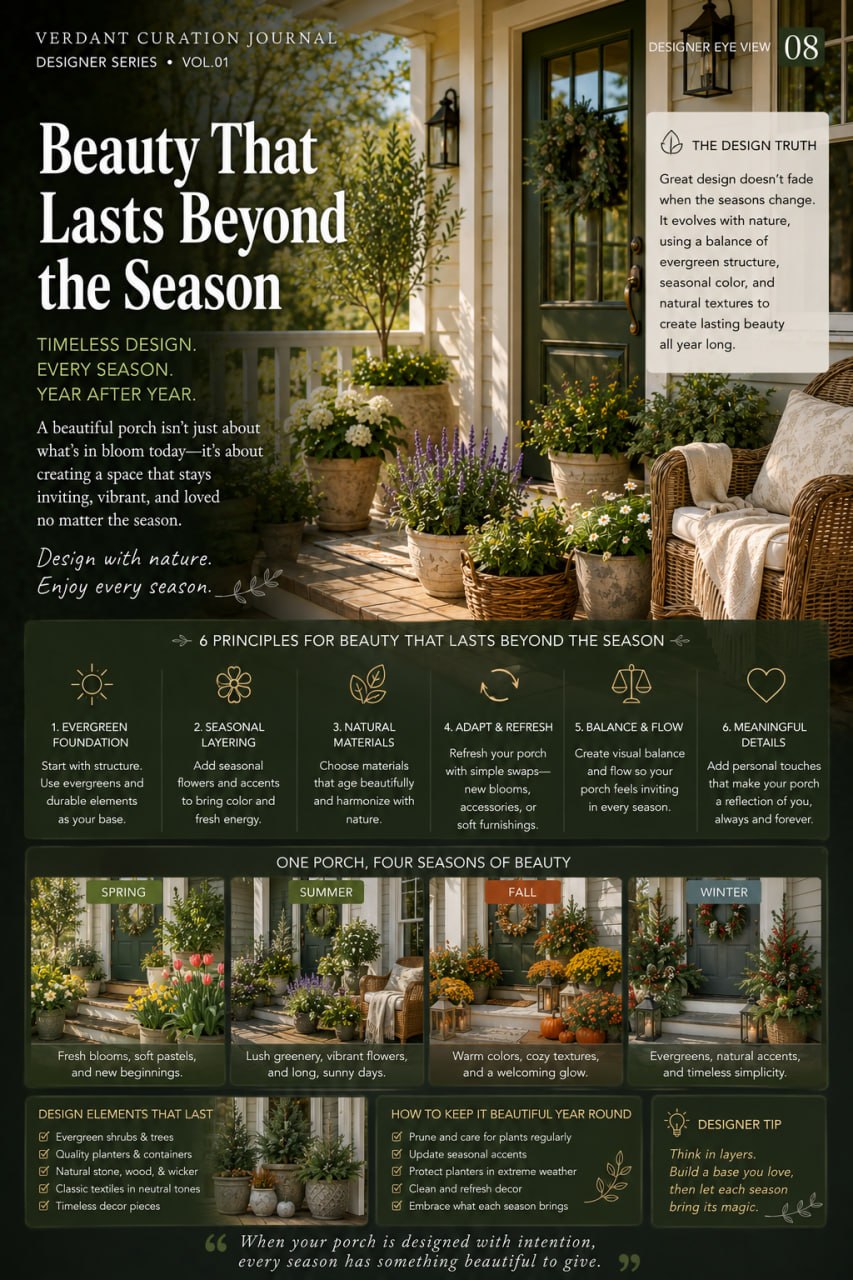
Designer Eye View page 08: Beauty Beyond the Season — designing a porch that stays inviting through all four seasons with evergreen foundations
A four-season porch is built on an evergreen foundation — the seasonal layers are just the finishing touches.

Beauty Beyond the Season

A porch that only looks good in June hasn't been designed — it's been decorated for a single moment.

Seasonal decorating is a joy, but a truly well-designed porch looks intentional in every season. The secret is building an evergreen foundation — permanent elements that work year-round — and then layering seasonal accents on top. Think of it as a capsule wardrobe for your porch: the classics stay, the accents change.

Start with the bones: quality containers in neutral tones, evergreen topiaries or dwarf conifers, hardscaping that weathers gracefully, and lighting fixtures that read as architectural. These elements provide structure and interest even in the depths of winter. Then, swap in seasonal flowers, ribbons, gourds, or evergreen cuttings as the year turns.

Winter reveals what summer hides. When the annuals die back and the leaves fall, your porch's skeleton is exposed. If the foundation is strong — good pots, good proportions, good lighting — the porch still reads as intentional. That's the mark of true design: beauty that doesn't depend on a single season to make its case.
Principle 07
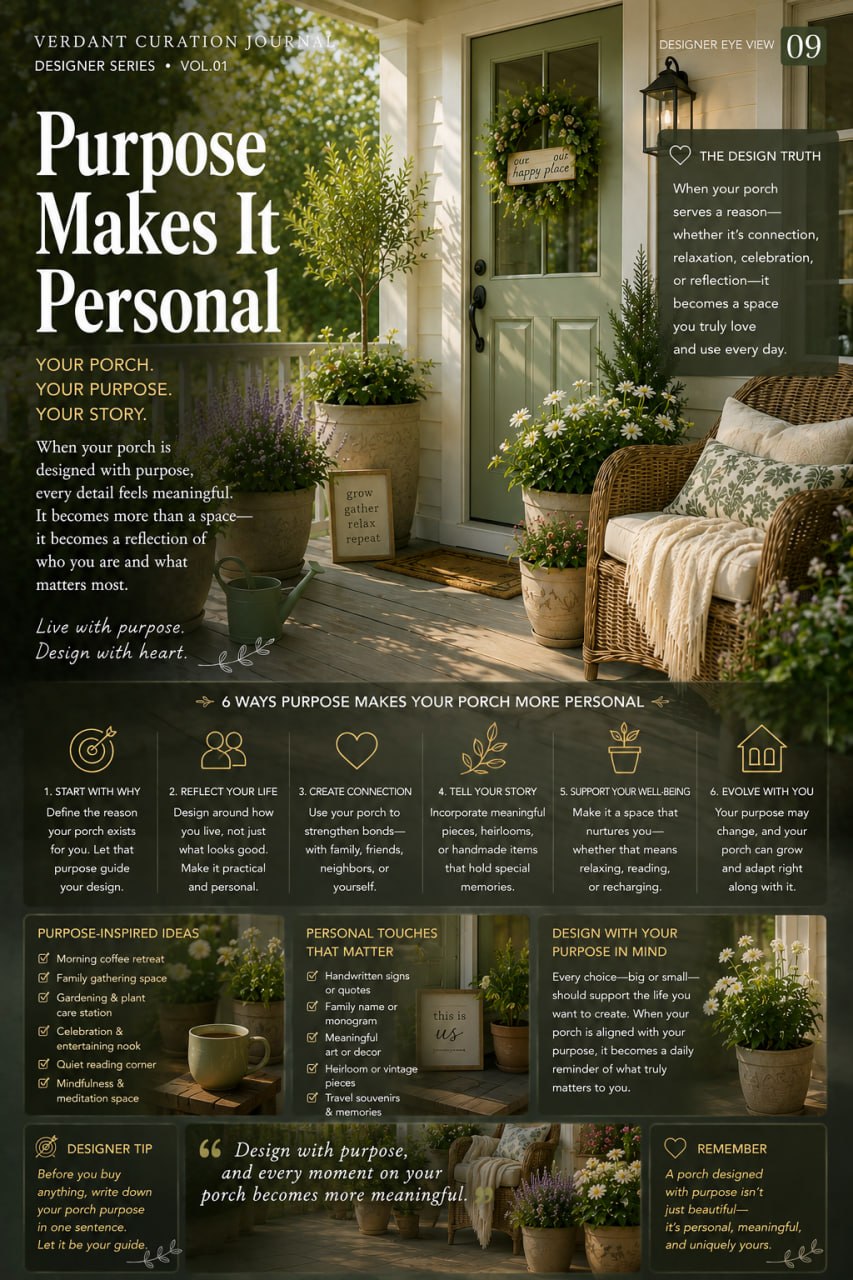
Designer Eye View page 09: Purpose Makes It Personal — how intentional design turns a porch into a reflection of your life and values
A porch that reflects your life will always be more beautiful than one that follows a trend.

Purpose Makes It Personal

A designer's most important question is not "What plants should I use?" but "How do you want to feel when you walk up to your door?" Purpose transforms a collection of nice objects into a personal statement. Without purpose, a porch is just decoration. With purpose, it becomes an extension of who you are.

Design with intention means every element earns its place. The vintage lantern that belonged to your grandmother. The pot in the exact color of your favorite sweater. The ferns that remind you of a porch from a childhood vacation. These aren't random choices — they're anchors of meaning that turn a house into a home.

Let your values guide your choices. Do you love native plants that support pollinators? Make them the centerpiece. Do you value quiet and simplicity? Choose a restrained palette with clean lines. Do you love to entertain? Design generous landing zones for glasses and plates. When your porch reflects what you genuinely care about, it will never look like anyone else's — and that's the highest compliment.

Principle 08
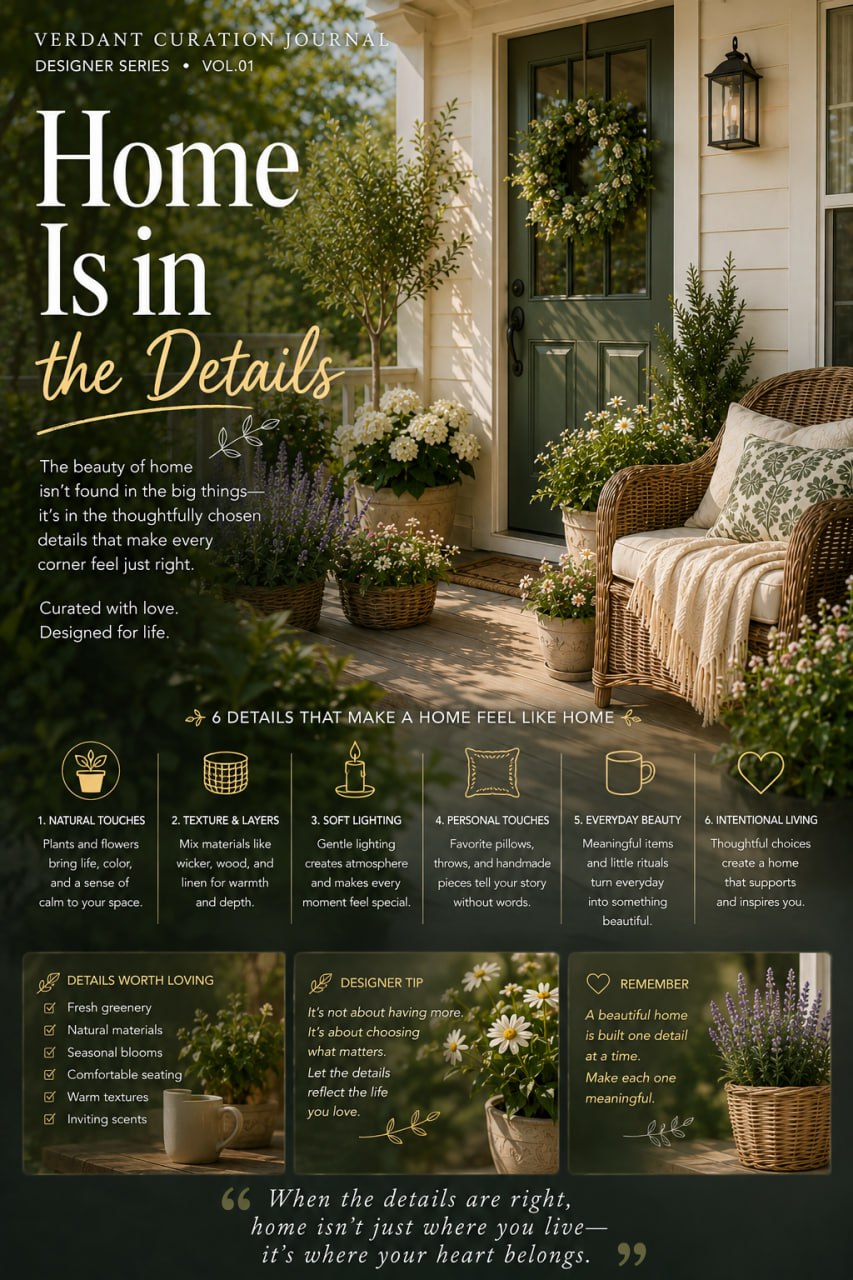
Designer Eye View page 10: Home Is in the Details — thoughtful details that make a home feel like home through natural touches and layered textures
The most welcoming porches combine natural elements with layered textures that invite touch and pause.

Home Is in the Details

There's a reason we say a place "feels like home" — and it's rarely because of the big gestures. Home lives in the small, thoughtful details. The doormat that says welcome without shouting it. The cozy throw draped over a chair on a cool evening. The tiny vase of fresh clippings on a side table. These are the details that make people slow down and breathe.

Natural touches are the most powerful. A branch of dried eucalyptus tied to a lantern. A collection of river stones arranged on a shelf. A piece of driftwood that becomes a sculptural accent. These elements cost almost nothing but add immeasurable warmth because they connect the porch to the larger landscape.

Layering textures creates depth. Wicker, wood, stone, metal, fabric, foliage — each material brings a different tactile quality. The eye moves across these surfaces, reading each one as a distinct note in a composition. When the textures are thoughtfully layered, the space feels rich without being busy, curated without being cold.

Principle 09
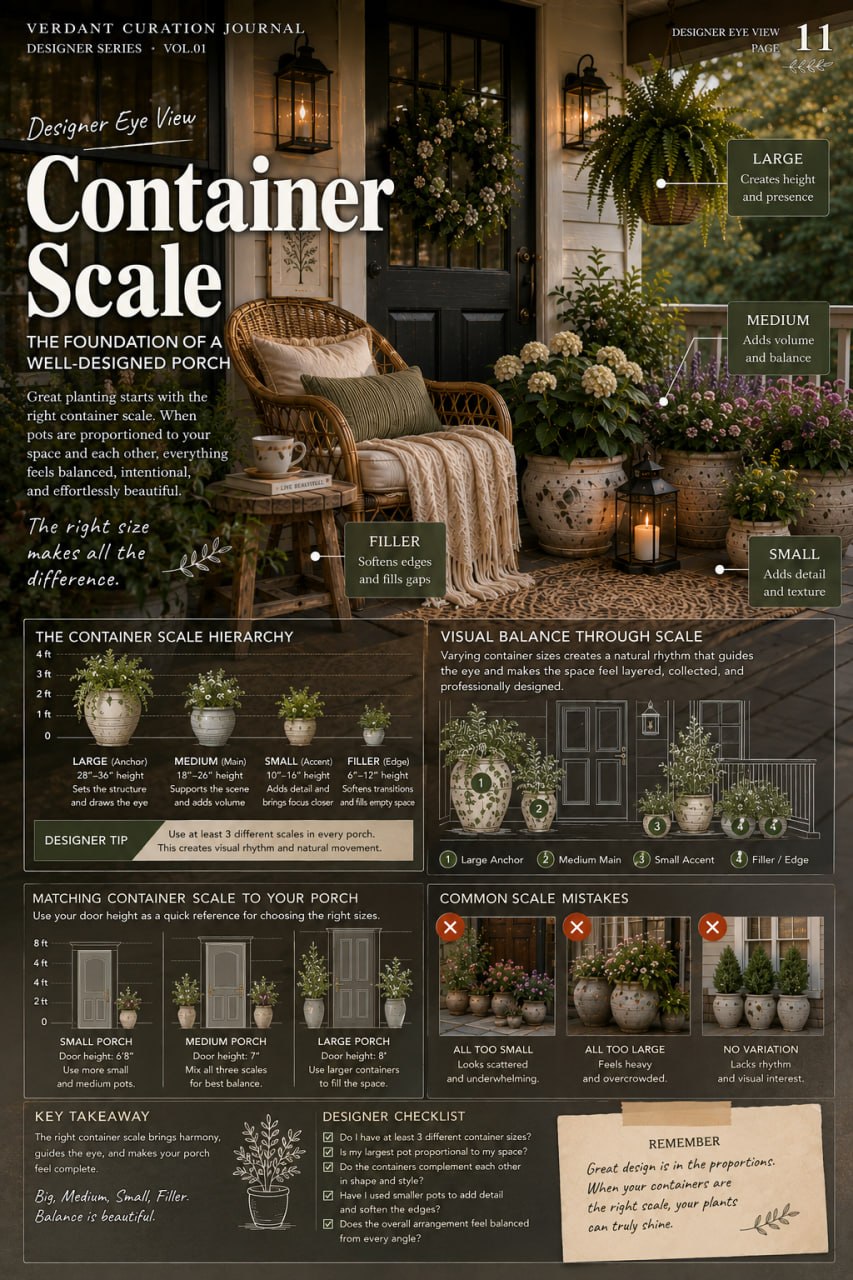
Designer Eye View page 11: Container Scale — the foundation of a well-designed porch with correct proportions for small, medium, and large spaces
Scale is the difference between a porch that feels grand and one that feels cramped — and it starts with the containers.

Container Scale

The number one mistake in porch design? Containers that are too small for the space they're meant to anchor.

Scale is the single most impactful factor in a porch composition, and it starts with your containers. A pot that's too small feels apologetic. A pot that's too large feels overwhelming. The designer's trick is to size containers to the architecture of the home, not just the plant inside them. A front door calls for a container that's at least one-third the height of the door itself.

For small spaces, a single large container reads better than several small ones — it creates impact without clutter. For medium porches, use pairs or groups of three in graduated heights. For large, expansive porches, don't be afraid to go oversized. The grandest pots anchor the entire composition and prevent the eye from wandering aimlessly across the facade.

The rule of thirds applies here too. A container-and-plant combination should fill roughly one-third of the height of the architectural element it flanks. That means for a seven-foot door, your pot-and-plant should reach about 28 inches. For a low porch wall, scale down proportionally. Trust the math — your eye will thank you.

Designer Insight
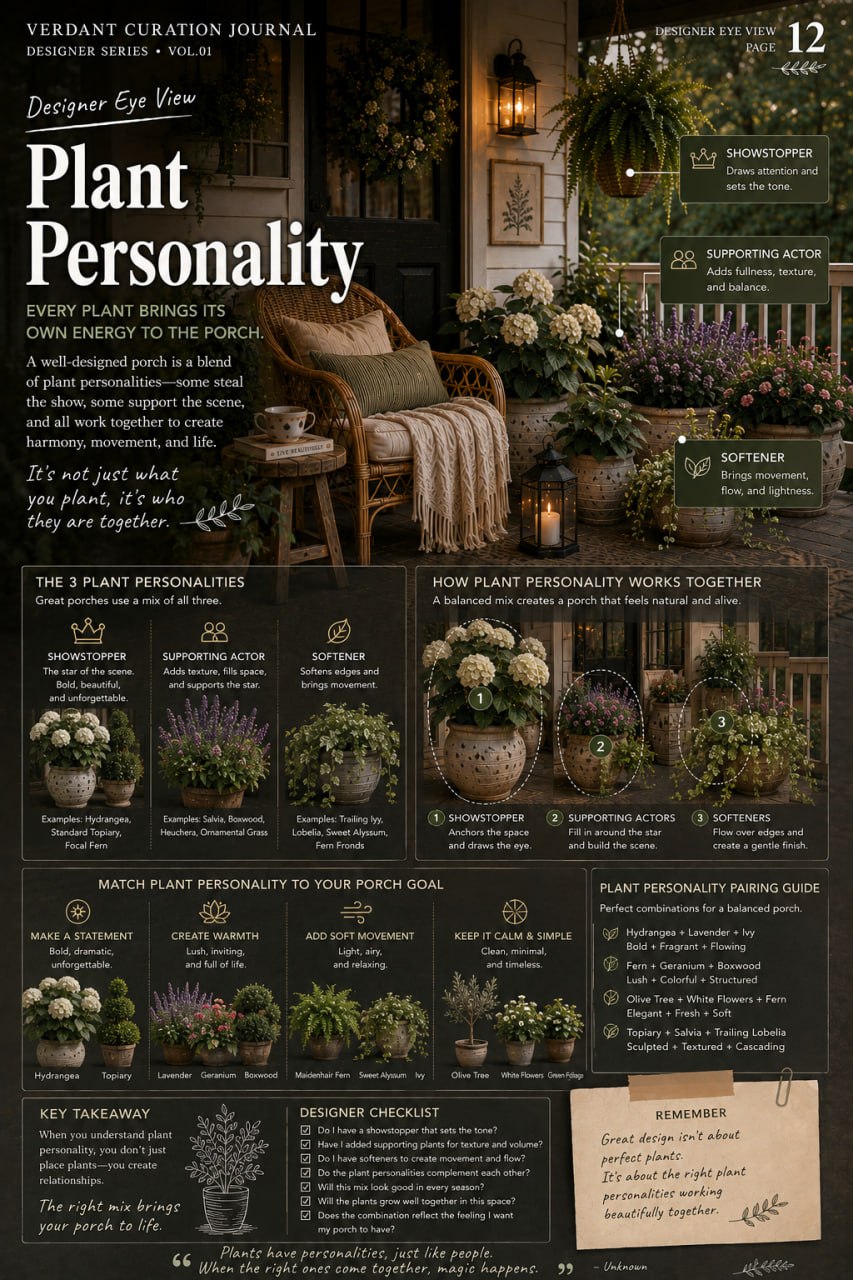
Designer Eye View page 12: Plant Personality — showstopper, supporting actor, and softener plant types that work together for porch harmony
Every great porch composition uses a deliberate mix of three plant personalities.

Plant Personality

Every plant brings its own energy to a porch. A well-designed porch uses a mix of three plant personalities — each playing a distinct role — to create a composition that feels complete and intentional.

The Showstopper

A bold, dramatic plant that commands attention. Typically large in scale, with striking foliage or flowers. It's the plant everyone notices first.

🎭

The Supporting Actor

Reliable, beautiful, and essential — but doesn't steal the scene. Supporting actors fill out the composition and give the showstopper context.

🌿

The Softener

Trailing, cascading, or airy plants that blur hard edges. Softeners create flow, reduce visual harshness, and make the arrangement feel organic and approachable.

When you combine all three personalities, the porch feels designed by someone who understands the emotional language of plants. One personality alone reads as incomplete. Two is better. Three is harmony.

"Combine all three personalities and your porch feels complete, intentional, and deeply personal."
Principle 10
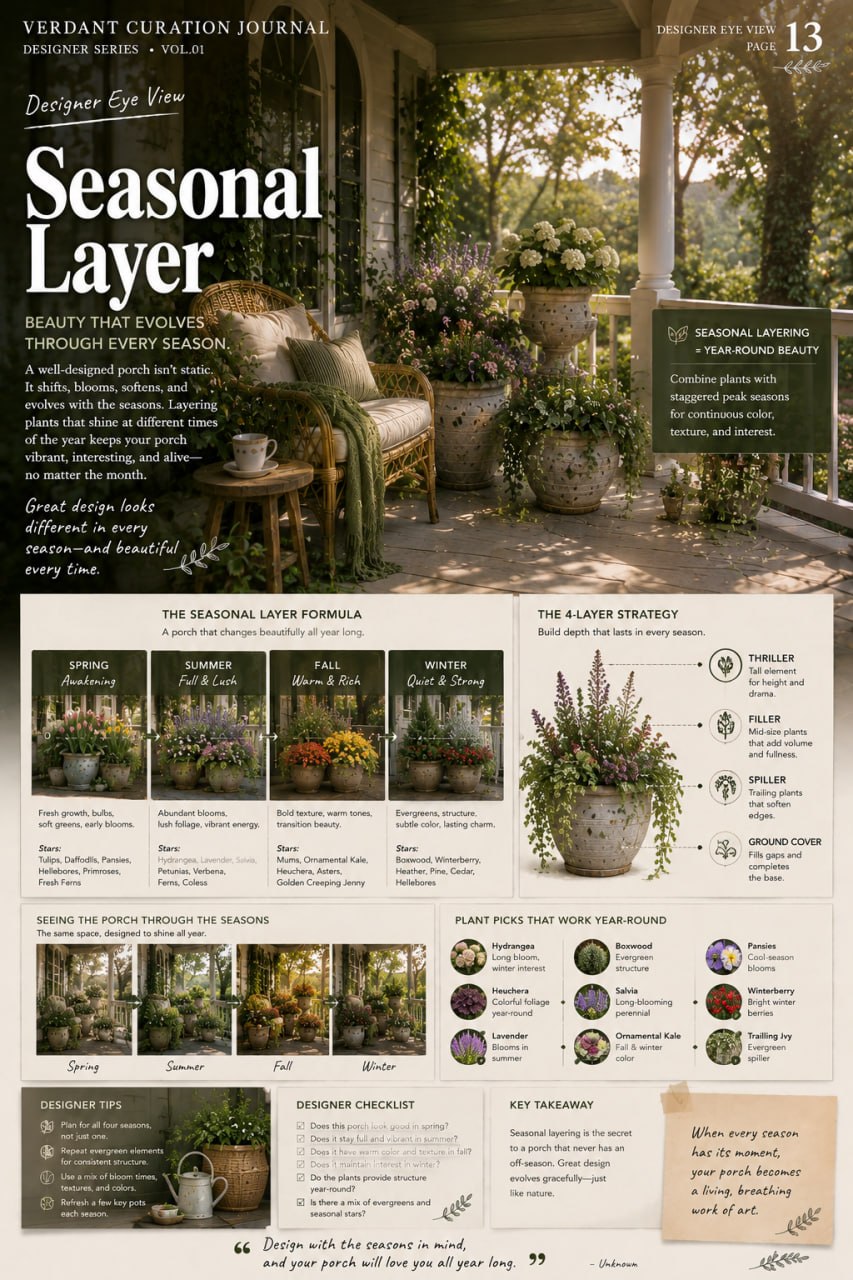
Designer Eye View page 13: Seasonal Layer — the four-layer strategy for porch beauty that evolves through spring, summer, fall, and winter
The four-layer strategy keeps your porch evolving with the seasons while maintaining a consistent design thread.

Seasonal Layer

A designer's porch changes with the calendar, but it never starts from scratch. The four-layer strategy is the professional method for creating a porch that feels fresh in every season while maintaining visual continuity throughout the year.

The Four-Layer Strategy

  1. 1
    The Foundation Evergreen structure — topiaries, dwarf conifers, boxwoods — that anchors the design year-round. These never change.
  2. 2
    The Seasonal Stars Hero plants that change with the season. Spring bulbs, summer annuals, fall mums and kale, winter hellebores.
  3. 3
    The Accent Layer Decorative elements — ribbons, gourds, ornaments, dried branches — that add seasonal personality without permanent commitment.
  4. 4
    The Ambient Layer Lighting, textiles, and seasonal scents that shift the atmosphere. Warm throws in winter, linen pillows in summer.

The beauty of this system is efficiency. You never redecorate from scratch. You simply swap one layer while the others hold the composition together. Your porch always looks intentional because the foundation never wavers — the season is just the accent.

Principle 11
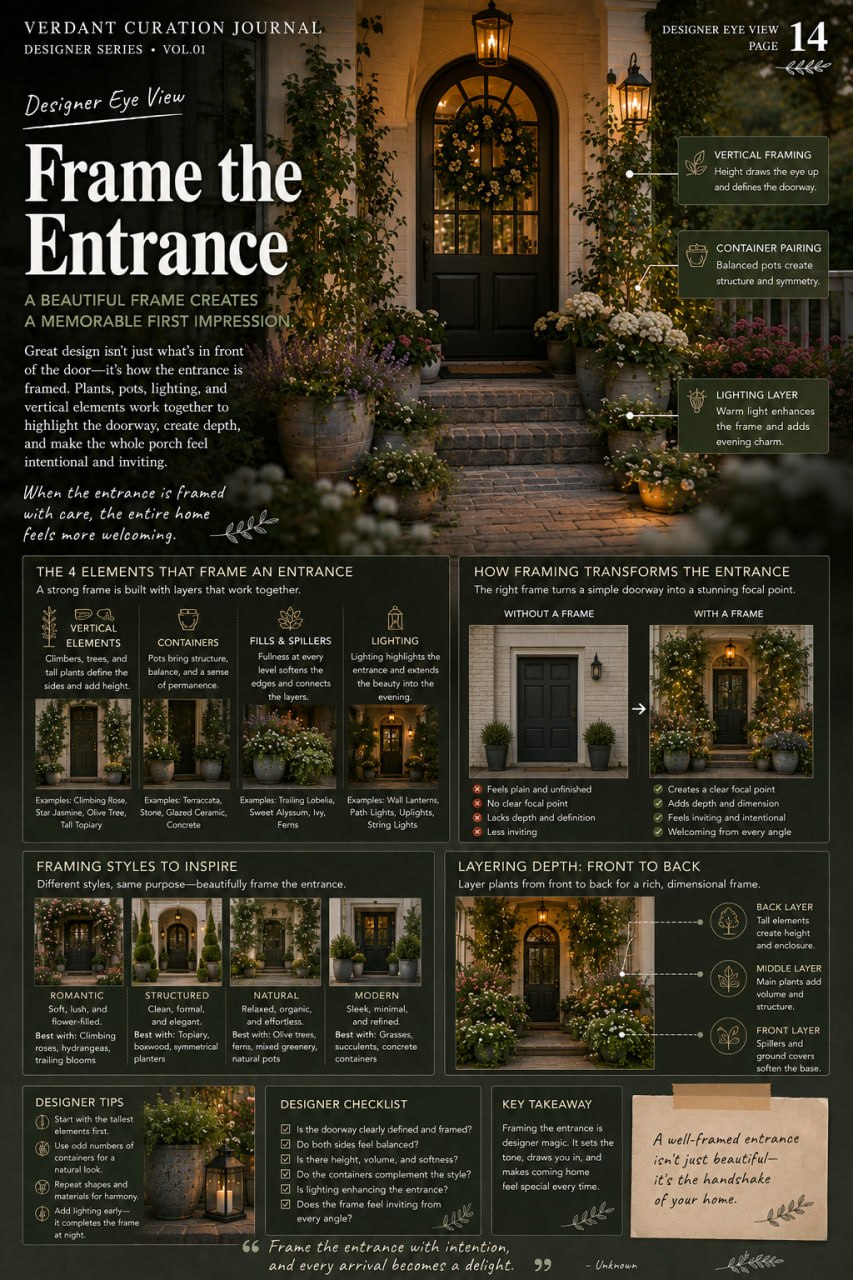
Designer Eye View page 14: Frame the Entrance — four elements that frame a porch entrance: vertical elements, containers, fillers, and lighting
The entrance is the focal point of your porch — frame it well and everything else falls into place.

Frame the Entrance

The door is the star of the show. Everything else on the porch should support, not compete.

Your front door is the natural focal point of any porch design, but it needs framing to truly shine. A door that sits alone — unflanked, unadorned, unsupported — feels like a period at the end of a sentence instead of an exclamation mark. The designer's job is to build a visual frame that draws the eye toward the entrance and announces it with intention.

4 Elements That Frame the Entrance

Think of your entrance as a portrait. The door is the subject. The planters, lights, and hardscaping are the frame. A good frame makes the subject look its best. A great frame disappears — you only see the beauty it contains.

Principle 12
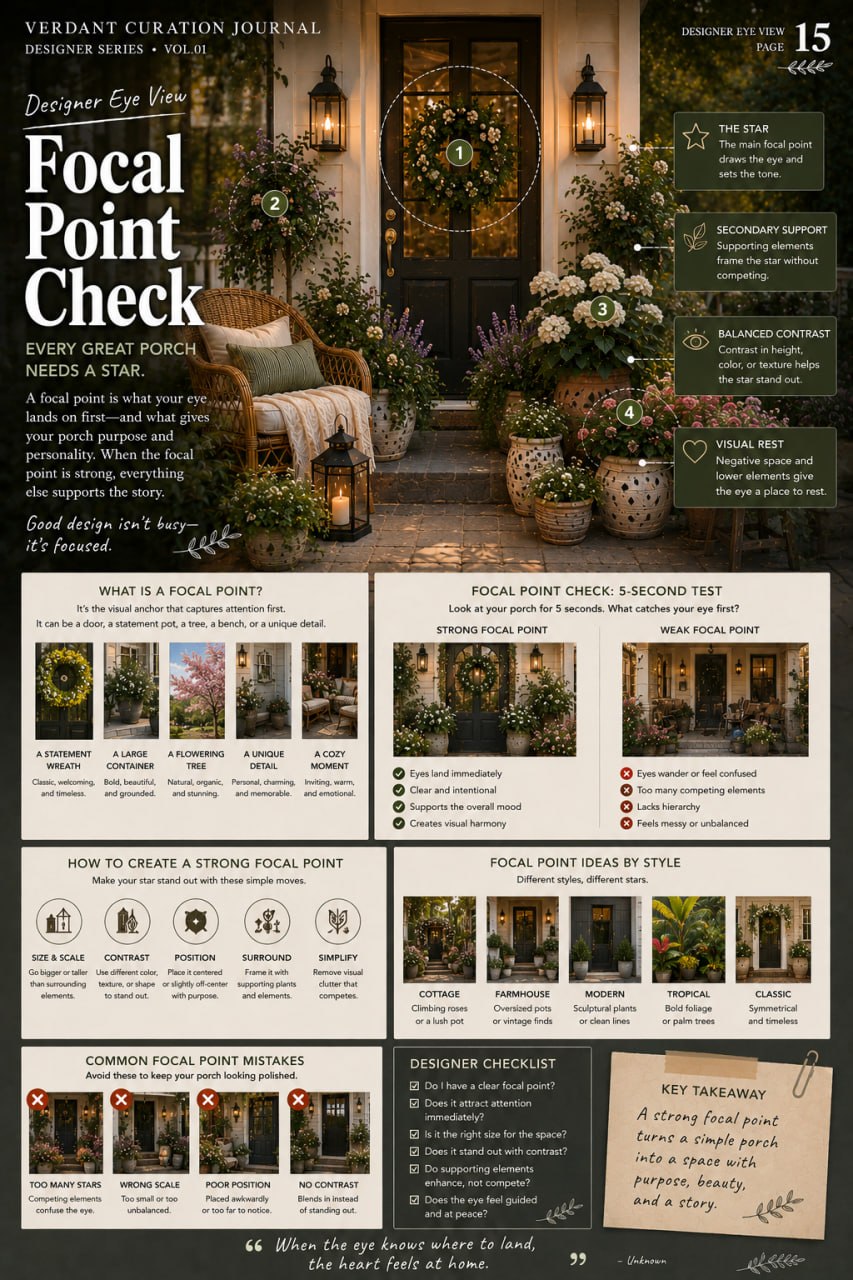
Designer Eye View page 15: Focal Point Check — how to create and identify a strong focal point for your porch design
Every great composition has one dominant focal point — find it, strengthen it, and build everything else around it.

Focal Point Check

A porch without a clear focal point feels scattered. The eye doesn't know where to land, so it travels restlessly from one element to the next without finding resolution. A strong focal point — a beautifully framed door, a dramatic statement planter, an architectural feature — gives the composition a center of gravity.

The professional trick is to identify your focal point first and design everything else in support of it. Your focal point should be the most visually important element on the porch. Everything else — the other planters, the seating, the accessories — should be quieter, stepping back to let the star shine.

Quick Check — Stand Back and Ask

One focal point. Everything else supports it. This is the single most effective rule in porch design. When you commit to one clear focal point, every other decision becomes easier — because you know what you're designing for.

From Theory to Practice
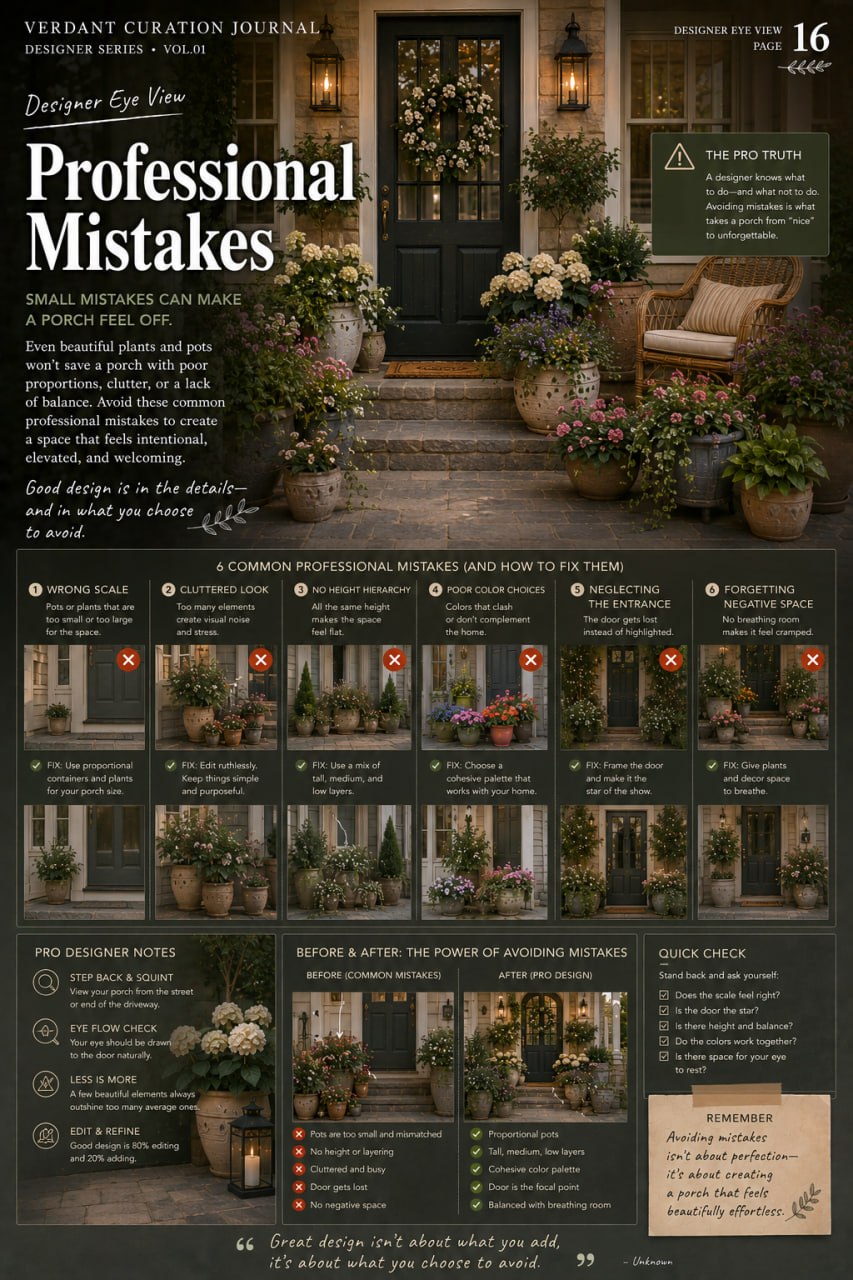
VC Journal — Professional Mistakes page showing 6 common errors and fixes
6 Common Professional Mistakes — and how to fix each one.

Professional Mistakes

Even beautiful plants and pots won't save a porch with poor proportions, clutter, or a lack of balance. Avoiding common mistakes is what takes a porch from "nice" to unforgettable. Good design is in the details — and in what you choose to avoid.

The Pro Truth: A designer knows what to do — and what not to do. Avoiding mistakes is what takes a porch from "nice" to unforgettable.

6 Common Professional Mistakes

01

Wrong Scale

Pots or plants that are too small or too large for the space.
Fix: Use proportional containers and plants for your porch size.
02

Cluttered Look

Too many elements create visual noise and stress.
Fix: Edit ruthlessly. Keep things simple and purposeful.
03

No Height Hierarchy

All the same height makes the space feel flat.
Fix: Use a mix of tall, medium, and low layers.
04

Poor Color Choices

Colors that clash or don't complement the home.
Fix: Choose a cohesive palette that works with your home.
05

Neglecting the Entrance

The door gets lost instead of highlighted.
Fix: Frame the door and make it the star of the show.
06

Forgetting Negative Space

No breathing room makes it feel cramped.
Fix: Give plants and decor space to breathe.

Pro Designer Notes

Step Back & Squint View your porch from the street or end of the driveway.
Eye Flow Check Your eye should be drawn to the door naturally.
Less Is More A few beautiful elements always outshine too many average ones.
Edit & Refine Good design is 80% editing and 20% adding.
Quick Check — Stand Back and Ask Yourself

"Great design isn't about what you add. It's about what you choose to avoid."

Transformation
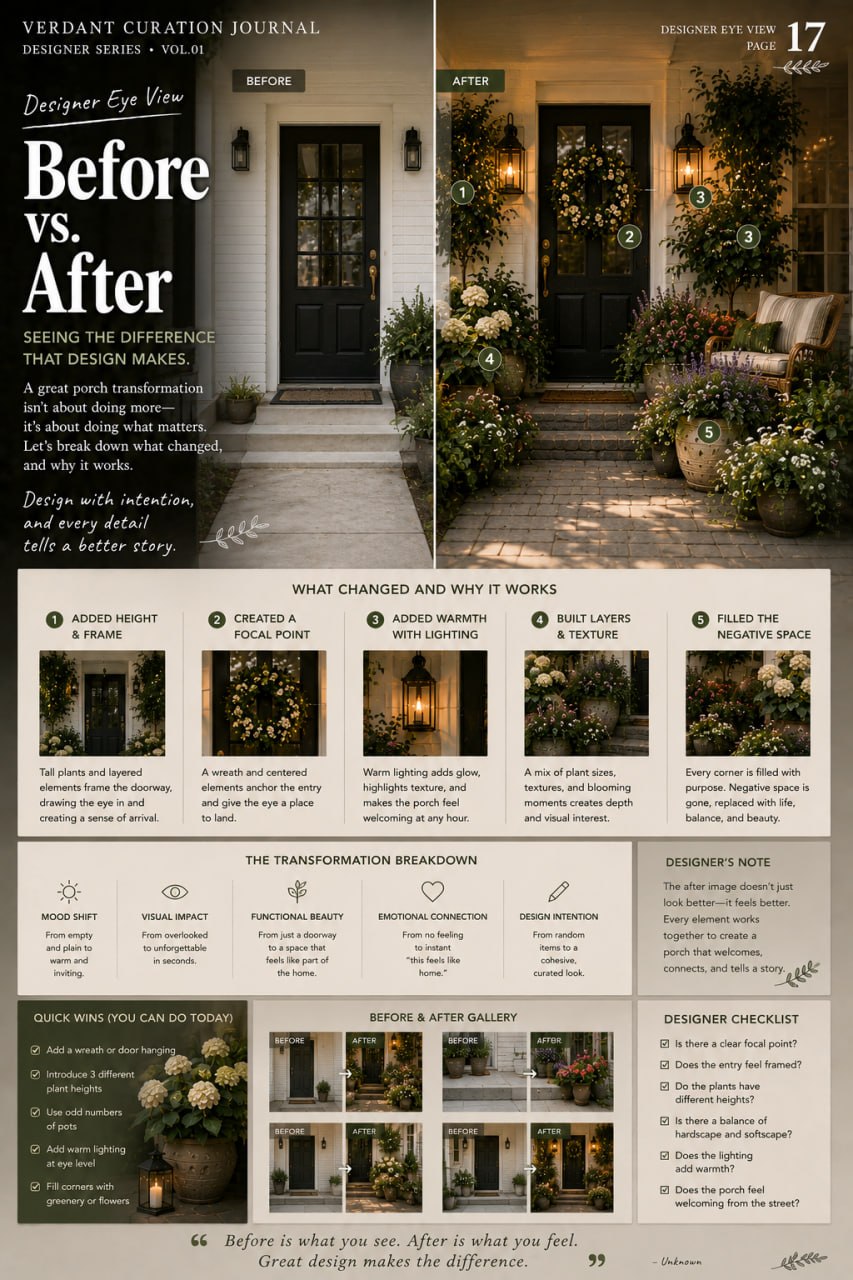
Designer Eye View page 17: Before vs. After — seeing the difference that intentional design makes in a porch transformation
The same porch, transformed by design principles — proof that intention changes everything.

Before vs. After

Sometimes the most powerful design lesson is a simple comparison. Take one porch, apply the principles from this magazine, and watch how intention transforms the same space. Below are two views — the starting point and the designer's intervention.

📷

Before

The Problem: Mismatched pots, no height variation, cluttered corners, and a door that disappears into the background. No focal point, no flow, no cohesive palette. The porch has potential — but it reads as an afterthought rather than an invitation.

After

The Transformation: Oversized matching urns frame the door. A clear height hierarchy creates depth. The palette is restrained and intentional — warm terracotta, deep green, cream. Negative space gives the eye room to rest. The door is now the undisputed star.

What changed? Not the architecture. Not the budget. Just the application of design principles: scale, balance, framing, focal point, and editing. The before version had more stuff. The after version has more intention.

Case Study
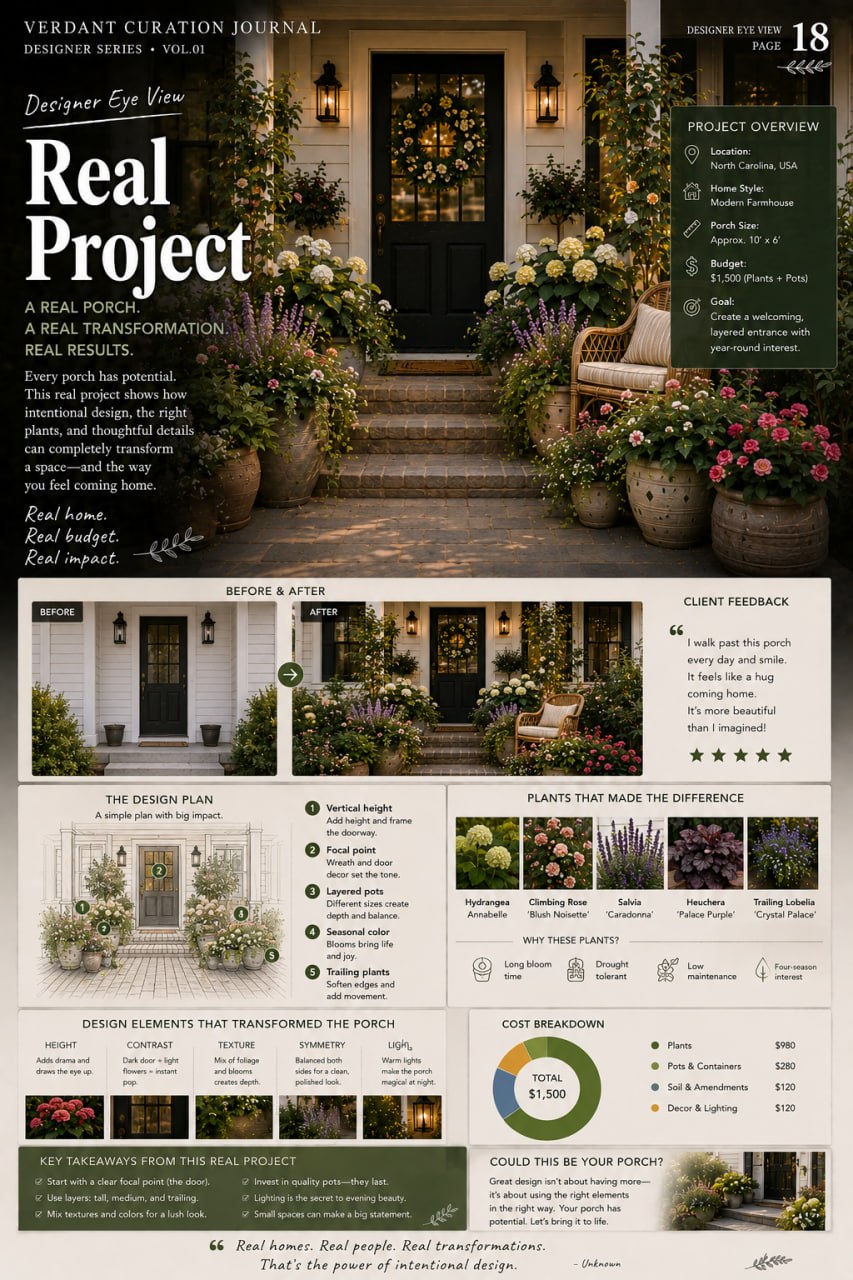
Designer Eye View page 18: Real Project — a real porch transformation with design plan, plant choices, and cost breakdown
A real-world porch transformation — from concept to completion with a detailed design plan.

Real Project: The Bungalow Porch

This project took a tired 1920s bungalow porch from neglected to unforgettable. The homeowners wanted a warm, inviting entrance that honored the home's character while feeling fresh and intentional. The budget was modest — under $1,200 — but the transformation reads as far more valuable because every dollar was spent with purpose.

Design Plan

  1. 1
    Focal Point The original door was painted a deep charcoal to anchor the composition. New matte black hardware and a brass kickplate added subtle luxury.
  2. 2
    Containers Two large glazed ceramic urns in a soft sage tone — one on each side of the door — create a formal frame. Total cost: $180.
  3. 3
    Plant Choices Evergreen boxwood spheres (foundation), purple fountain grass (showstopper), licorice vine (softener). Three personalities, one composition.
  4. 4
    Lighting Two aged-brass sconces flanking the door, plus a warm LED uplight at the base of each urn. Total cost: $240.
  5. 5
    Details A coir doormat in a geometric pattern, a small bistro table with a single potted succulent, and a vintage lantern on the step. Total cost: $85.

Total project cost: $1,145. The transformation took one weekend and proved that you don't need unlimited resources — just unlimited intention. Every element serves a purpose. Nothing is random. That's the designer's eye at work.

Practice
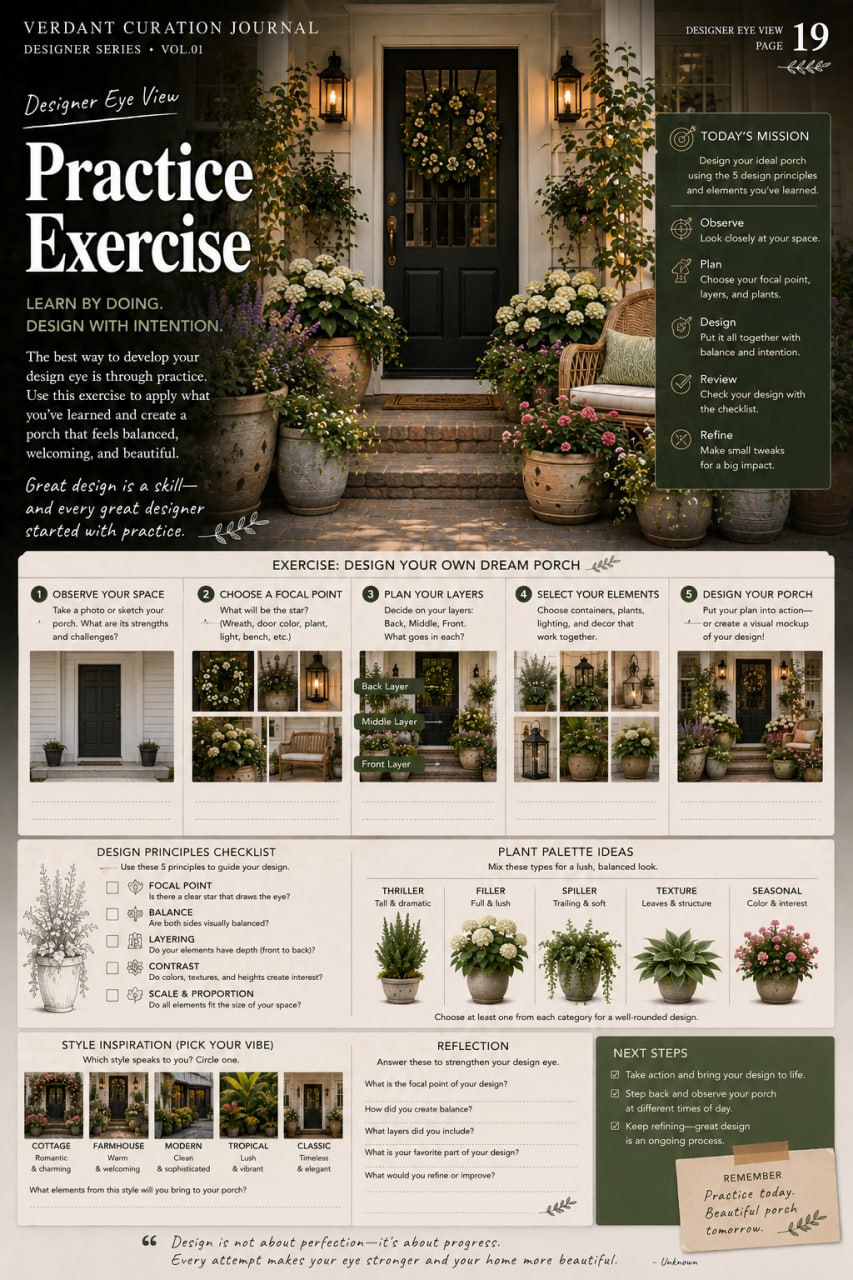
Designer Eye View page 19: Practice Exercise — a hands-on exercise to practice porch design principles
Put the principles into practice with a simple but powerful exercise.

Practice Exercise: Design Your Own Porch

Reading about design is one thing. Doing it is where the real learning happens. This exercise will help you apply the principles from this magazine to your own porch — or any porch you want to reimagine. Take 30 minutes and work through each step.

Step-by-Step Exercise

  1. 1
    Take a Photo Stand at the street or driveway and photograph your porch as it is right now. Don't tidy up first — capture the honest starting point.
  2. 2
    Identify the Focal Point Where does your eye land first? If it's not the door, what is competing? Write down one change you could make to strengthen the entrance.
  3. 3
    Check the Scale Are your containers too small? Measure them against your door height. Note any container that needs to increase in size.
  4. 4
    Edit Ruthlessly Remove three things from your porch right now. Anything that doesn't serve a purpose, doesn't bring joy, or distracts from the entrance.
  5. 5
    Write Your Plan On paper, sketch or list your ideal arrangement. Use the three plant personalities. Plan for four-season interest. Commit to one change this week.

The goal isn't perfection — it's progress. Even one intentional change will shift how your porch feels. Try it, observe the difference, and build from there. That's how a designer's eye develops.

"The designer's eye isn't something you're born with. It's something you practice."

Final Review
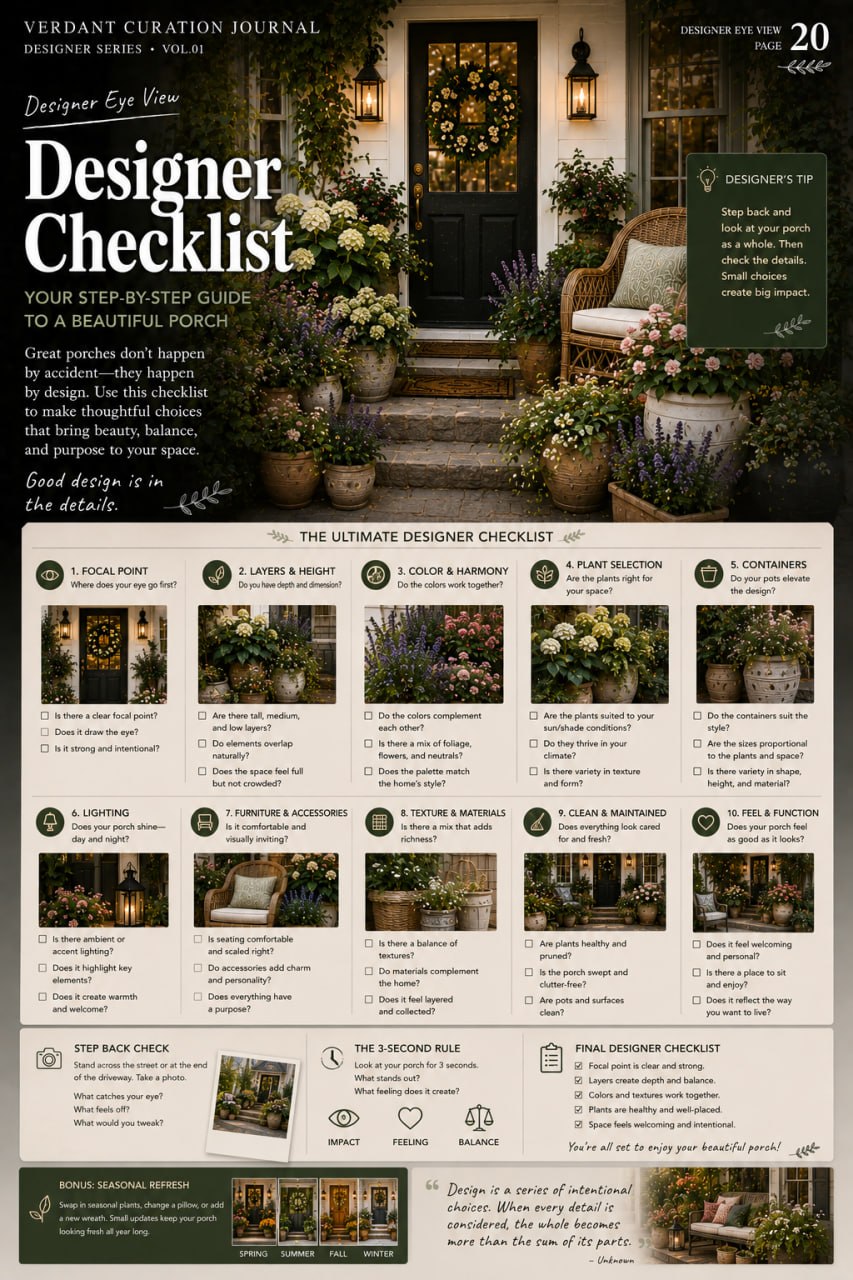
Designer Eye View page 20: Designer Checklist — final checklist to evaluate and complete your porch design
The complete designer checklist — evaluate your porch against every principle from this magazine.

Designer Checklist

Before you close this magazine, take a moment to evaluate your porch against the principles you've learned. This checklist captures everything — from the designer's first look to the finishing details. Use it as your roadmap for creating a porch that feels intentional, balanced, and deeply personal.

The Complete Designer Checklist

Your porch is a living canvas. It will grow, change, and evolve — that's the beauty of designing with plants and intention. The principles in this magazine aren't rules to follow once and forget. They're tools you can return to again and again, each time seeing your space with fresh eyes and a designer's perspective.

"You don't need a degree in design. You just need to learn how to see."

Issue 001 · Designer Eye View Series
Browse All Articles

Twenty screens · Complete designer series · Published